Throughout its long course from 1885 to the present, the little house by the Odigitria where Foscolo spent his childhood years always drew the attention, respect and pride of the people of Zakynthos. In that span of time, when prosperity alternated with decline and destruction was followed by renewal, there were always voices that stressed Zakynthos's duty toward her worthy son, the poet of the Tombs. There was always concern for safeguarding and preserving his memory and for rendering due respect and honour to the poet and his house, and protest whenever these were endangered by human indifference or neglect.
The result of publications and protests was the saving from demolition in 1885 of the then dilapidated and uninhabited little house through its purchase by the Municipality of Zakynthos in 1886.
The result of the efforts of a few fellow citizens was also the erection of today's Foscolo House.
Exactly where Foscolo was born is not known. De Biasi, who had researched the pre-earthquake Archive seeking this information, found nothing relevant. Konomos states that he was born in the house of the Spathis family, his mother's parental home, in the district of the Holy Apostles, where his parents' wedding had also taken place.
In the house in the Odigitria district, in Barakiotika, property of Dion. Chariates, the family settled in October 1780, when Nicolaos was almost three years old, and remained there until 1785, when they moved to Spalato in Dalmatia. According to the lease drawn up by the notary Io. Frantzis at that time, in 1780, the house was single-storey, between two tall buildings, almost opposite the church of the Odigitria, and had «a portico, two rooms, a small room, a kitchen and an attic».
Over time the house changed many owners, served various uses and was neglected.
The municipal authorities, while they had delayed and failed to bring the poet's remains from England to Zakynthos, paid no attention at all to his house. And so, while everyone honoured the poet, no work, no monument had been created to prove it and to declare his Zakynthian origin.
Of course a Foscolo club had been founded as early as 1843, and the Municipal Theatre was named Foscolo in 1870 and a relief plaque with the poet's likeness was set into its façade at that time. Yet around 1880, as foreign visitors sought it out, the question of Foscolo's house had become pressing. And a hundred years after the poet had lived there, voices called for it to be repaired, for some inscription to be placed, and for the poet's name to be given to the street where it stood.
A pity for your immortal wealth, a pity
that so much filth and ugliness should pasture there.
Shame! The West raises yet another tomb
to the poet whose first divine speech you heard,
his first cry,
when he was sent to earth from his God.
And the house said:
Dilapidated, filthy, as I lean before you
I shall be a mirror for your face!
wrote Tsakasianos in 1881, castigating the indifference of his fellow citizens.
A description of the house as it was shortly before it was purchased by the Municipality was given by Grig. Xenopoulos. […] Low, single-storey, he writes in Estia of Athens in 1889, with only two windows, dwarfed still more among its tall neighbours, it hides beneath its coarse plaster its awkward and antiquated appearance. […] It had become wretched and dilapidated, he notes, so that for years it had no longer been inhabited. The basement was a wine shop, and from the small courtyard that had seen the poet's childhood leaps there echoed the nasal voices of drunkards..[..].
The last owner of the house, the merchant Ilias Makris Pachyiannis, in 1885 applied to the municipal authorities for a demolition permit in order to rebuild it. Protests then broke out in the press. Sp. De Biasi and Andreas Martzokis took the lead with articles that compelled the municipal authorities not to issue the demolition permit until the Municipal Council convened, which subsequently resolved to purchase it for the Municipality of Zakynthos.
The little house by the Odigitria was not the only house Foscolo inhabited. After his father's death and the family's return from Spalato to Zakynthos in 1788, he was lodged, owing to financial hardship, in the house of Ioanna Spathi Michalitse, his mother's sister, later the second wife of Antonios Someritis, in the district of Agios Eleftherios. There he spent his adolescent years until early 1793, when he left Zakynthos for good at the age of fifteen. That house — «the little house by the Ascension, property of Stithos…» as it then was — was demolished before 1885. For this reason Andreas Martzokis urged Mayor Loukas Karrer never to «tolerate seeing carried out a sacrilege like that committed years before, the destruction of another monument of glory, namely the demolition of the dwelling in which our fellow citizen and peer of Solomos lived while still a youth», noting that he possessed «a most artistic sketch of this dwelling, and perhaps the only one that exists in Zakynthos». A drawing of that house, the home of Ioanna Spathi Michalitse, was published in 1990 shortly before his death by Nt. Konomos, and later also by Dion. Mousmoutis as the Someritis house.
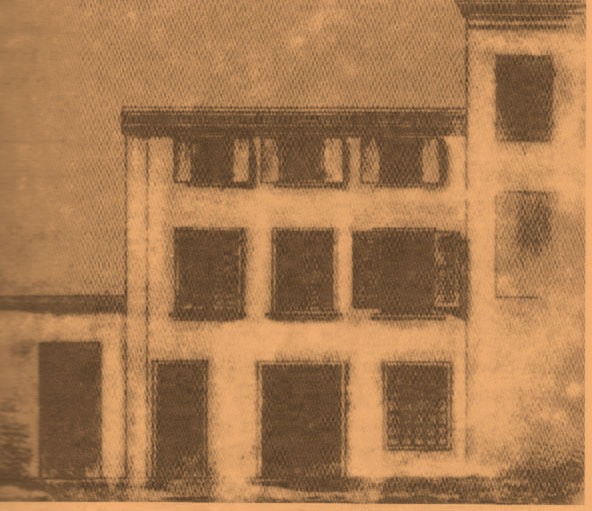 The house of Ioanna Spathi Michalitse, sister of the poet's mother, in the district of Agios Eleftherios, where Foscolo lived in his adolescent years (from the book by Nt. Konomos, Sources and testimonies for the childhood and adolescent life of Nicolaos Foscolo in Zakynthos. Athens 1990
The little house by the Odigitria, however, which was preserved and in which the whole family lived together and Foscolo's character was shaped in his earliest childhood years, is the one regarded as the Poet's House. The purchase of the house in 1886 was followed by its repair and the setting of a commemorative plaque into the façade in 1892, under Mayor Anastasios Lountzis. «House wherein Ugo Foscolo was born on the 26th of January 1778, purchased by the Municipality for eternal remembrance, placed by resolution of the Municipal Council 1892.»
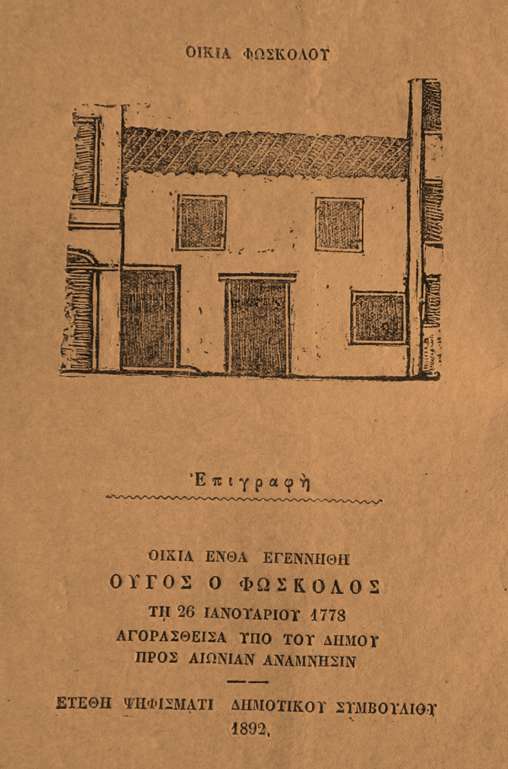 Plan of the house of Ugo Foscolo, 1892, and the inscription placed on the façade [From the pamphlet Unveiling of the votive plaque on the birthplace house of Ugo Foscolo. In Zakynthos 1892
Satisfaction and enthusiasm were general, and the entire intellectual world welcomed the event.
Open… Open the door of the house
Where the great poet of the Tombs was born[…]
………………………………………………………..
let the nest of the sky-dwelling eagle become
A holy shrine for the orphan homeland
For coming generations let it remain a monument of glory
As a page of our love in his memory
wrote Dion. Iliakopoulos, and Tsakasianos, who had earlier castigated indifference toward the house, now greeted the poet
"who advances and enters
The building whose very spiders speak
And there summons the whole inhabited world".
Mayor Loukas Karrer regarded the operation in this house of a Municipal Foscolian Library as the most fitting use of the Foscolo House. «The head of the Municipality,» writes De Biasi, «resolved that it should be the seat of a municipal Foscolian Library and that beside an expert the immortal works of Foscolo should be interpreted.» Thus in 1888 the Foscolian Library was founded, open to the public, with the aim not only of collecting and presenting the works and everything related to the poet but also of gathering there «books of other kinds useful for study, manuscripts, pictures, antiquities and everything of historical value, with the ambition of becoming worthy of the name with which it was adorned».
The Library began to operate at once with books that came chiefly from donations, with a core of 400 books given by De Biasi, and also from purchases by the Municipality of Zakynthos. De Biasi was appointed unpaid curator on the proposal of the Foscolian committee. That committee, to which the matter and the negotiations for the purchase of the house had been entrusted, consisted of the Deputy Mayor Count Ant. Flambouriaris, municipal councillor Ioannis Papadatos, the Italian consul Const. Messalas, and Io. Domeneginis, Io. Plessas, Memnon Martzokis and Sp. De Biasi.
The house of Foscolo and the Foscolian Library, with Sp. De Biasi as curator from 1889 and for many years until a few years before his death in 1927, knew periods of flourishing. Donations of books, pamphlets, manuscripts and heirlooms enriched the Library's holdings, and scholars and visitors crossed the threshold of the house with respect for the poet's memory.
The Italian scholars of Foscolo G. Martinetti, Antona Traversi, Grotta, A. Giordano and many others then donated books, and the Zakynthians Dim. K. Narantzis, a relative of the poet, rare editions of Foscolo's works with his autograph signatures, Zois, Tsakasianos, Martzokis and others. Manuscripts were donated by Sp. Pelekasis — his father's manuscripts, those of the physician-philosopher Dimitrios Pelekasis, the chronicles of Zakynthos, and the manuscript with the translation of Pastor Fido by Mich. Soumakis — Ant. Flambouriaris, a topographic map of the Castle of Zakynthos, and many others: K. Vlassopoulos, K. Therianos, Dim. Matesis, Georgios Manesis, Georgios Verykios, Sp. Kourtsolas, And. Laskaratos; and manuscripts of Dion. Therianos were gathered, letters of Solomos, of Tertsetis, of Antonios Matesis, correspondence of Georg. Verykios with Lombardos, Momferratos, Arist. Valaoritis, P. Vrailas and others, correspondence of Andr. Martzokis with Kolotzis and A. Viaginis concerning the Foscolo House, translations of Foscolo's early poems by Arist. Kapsokefalos, codices and patriarchal documents, historical writings, poems, books, periodicals and newspapers relating to Foscolo and more. The interior of the house was adorned with portraits of Ang. Konomos, the poet's godfather, Antonios Martelaos, his teacher, works by Koutouzis and Kantounis, portraits of Manzoni, Cornelio Ioasaf, Ioulios Typaldos, Katiforis and others.
For the unknown and today lost contents of the Foscolo House these items of information and news are invaluable.
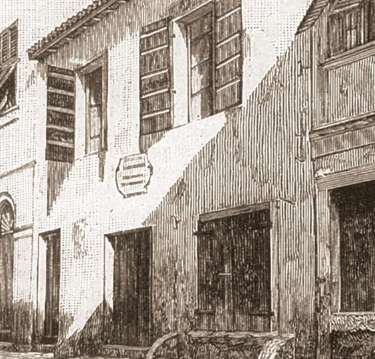
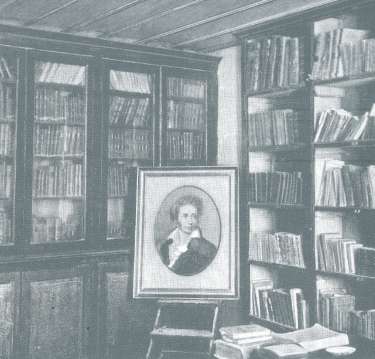
The little house and the library are mentioned by Ludwig Salvator, who visited Zakynthos in 1900 and also preserves a photograph of the façade of the house and of the library interior with Foscolo's image in a prominent place.
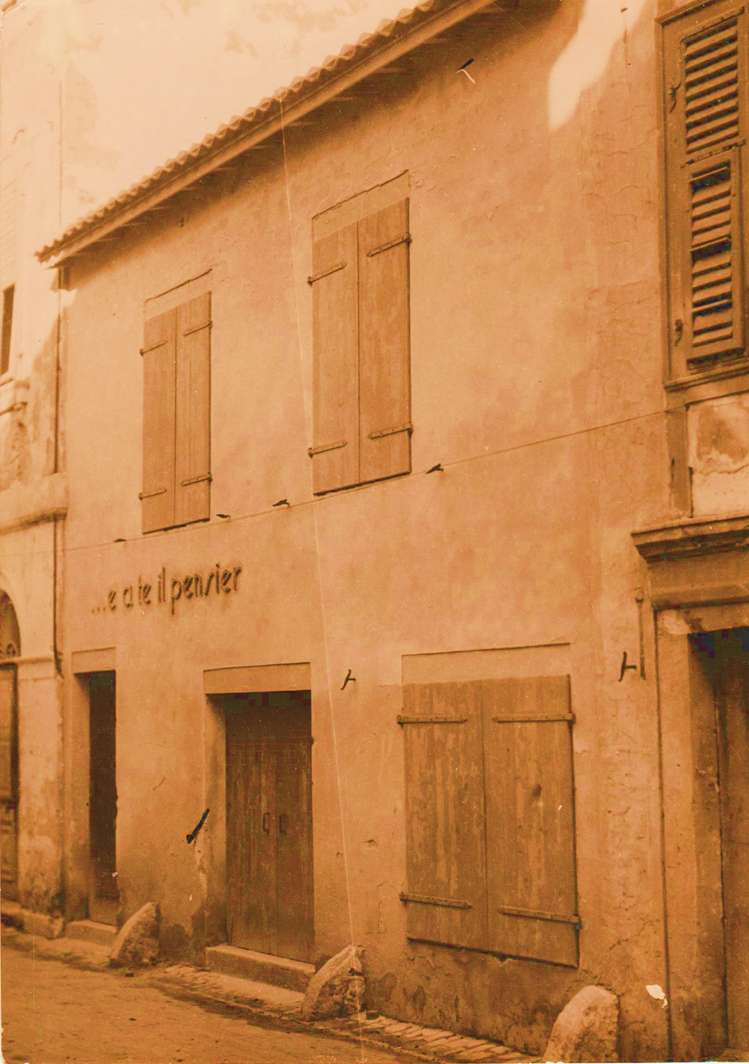 The Foscolo House in 1904 (from the book Zante by Ludwig Salvator)
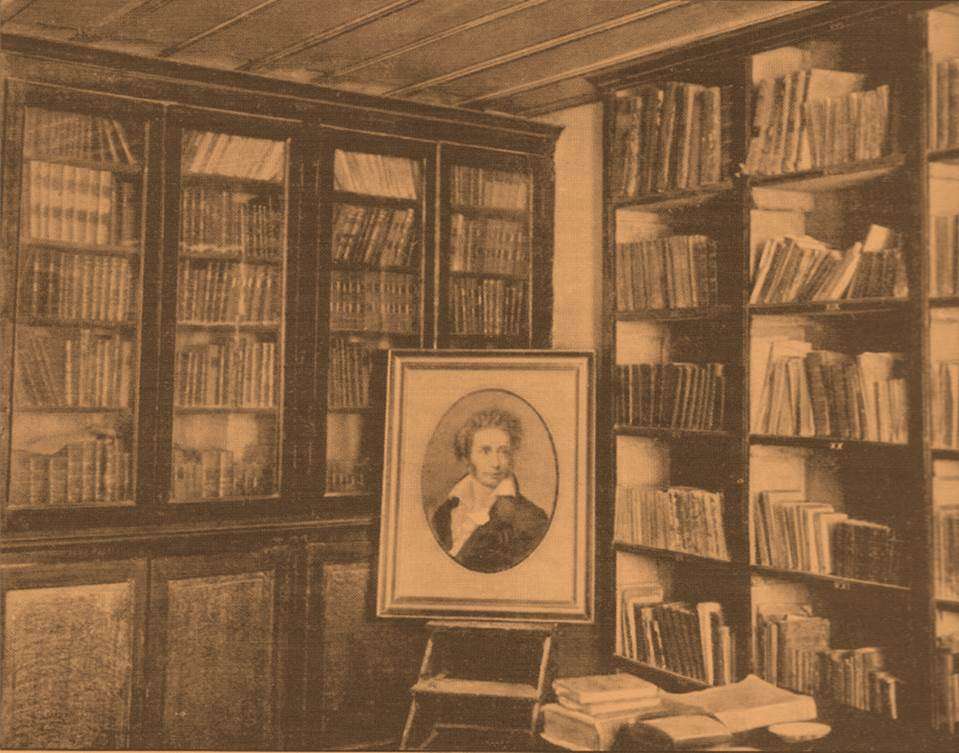 The portrait of Ugo Foscolo and a view of the interior of the Foscolian Library in 1904. (From the book Zante by Ludwig Salvator)
The Municipality of Zakynthos, to which the house and the Foscolo Library belonged, managed them and, according to its financial means, always provided for their maintenance, entering in the relevant budget chapters sums for repairs to the municipal little house, for the salary of a caretaker-assistant to the unpaid curator, for enriching the Library and for an annual subsidy for its operating expenses. When needs required it, it also covered extraordinary costs.
In times of poor municipal finances the sums were cut or the post of caretaker-assistant was abolished, often by the Prefecture, without the consent of the Municipal Council, and despite its protests and appeals to the Ministry of the Interior.
Indeed, regarding the cutting of expenses in 1893 the then Prefect Pan. Matarangas expressed the view — a view that also found supporters — that «it ought to be merged with the public [library] and only a Foscolian section kept in Foscolo's house, while the books in it not concerning Foscolo should be transferred to the Public [Library], and thus the debt-laden Municipality be relieved of its ever unnecessary expenses[…]».
The difficult period for the house and the Library began in 1913 owing to the generally poor economic condition of the place resulting from the Balkan Wars of 1912–1913.
In the years that followed, with the world war, the unsettled political situation, the blockade, the French Occupation (1916), the Asia Minor campaign and catastrophe and the attendant economic crisis, the standstill of trade and the poverty of the citizens, the Municipality, lacking revenues, fell into such a financial state that it was wholly unable to maintain the municipal buildings as it should. And the little Foscolo house, sharing the fate of the municipal buildings, had fallen into a bad condition: water entered through the roof and the books «lying on the floor and mixed together were being ruined day by day».
Repairs were carried out in 1926 [mayoralty of Dion. Ithakisios, 1925–1929] under pressure from protests and publications about the wretched state of the house and the books.
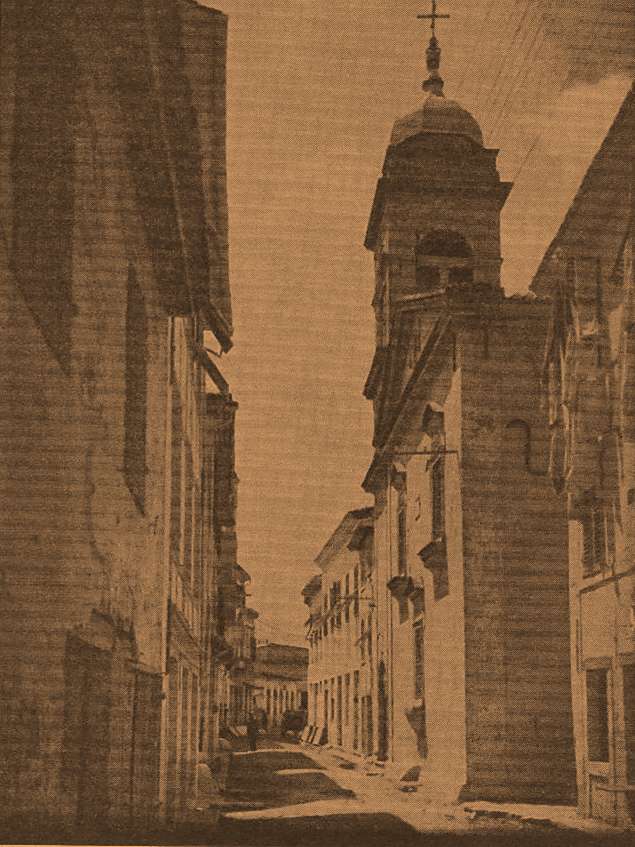 Foscolo's house [the first on the left] before 1940. It retains the plaque with the inscription and damage to the façade is visible. [Eptanisiaka Fylla IX,1,1976]
At that time the interior, the exterior and the roof of the little house were repeatedly repaired. Referring to unfavourable publications, Dion. Dasis, politically aligned with the municipal authorities of the day, stressed that those protesting about the condition of the little house ought also to write at length about the «actions and tireless efforts» being made for the repairs of the house, which, however, as a newspaper of the same political camp also observed, for some time and owing to De Biasi's advanced age «never or only very rarely opened for public use».
In any case the celebration of Foscolo's centenary in 1927 and the need for the little house then to be in good condition — «[…] something must be done so that foreigners do not see us like this […]» — contributed to its being repaired and renovated. The repairs continued for the reception of Italian officials who came to lay a bronze wreath on Foscolo's bust in 1928. On the occasion of the centenary celebrations, at any rate, a bust of Foscolo, an heirloom of the Valaoritis family, was also donated to the Municipality by Zoe I. Valaoritis «with the request that it be placed either in the hall of the Town Hall or in the Foscolo Library if it is to be renovated», as well as a deluxe edition of Foscolo's works from the Italian Government with a handwritten dedication by Mussolini.
In March 1927 Sp. De Biasi died; by his will he bequeathed to the Municipality his personal library together with manuscripts, private letters and unpublished works of his. De Biasi's books were transferred at the end of 1927 from his house to the Foscolian Library, placed there and catalogued in 1930–1931 under Mayor Anastasios Merkatis by the theologian Dionysios Dim. Papagiannopoulos, for a fee of 5,000 drachmas, with the help of the librarian Georgios Konofaou, who had already drawn up, from 1927, the catalogue of the Foscolian Library's books.
A picture of the wealth of the De Biasi Library is given in a related pamphlet printed in 1931 by the Municipality of Zakynthos. The manuscript ledger recording the contents of the Foscolian Library — books and pamphlets — drawn up by Konofaou has unfortunately not survived.
After De Biasi's death the unpaid curators in succession were the professors Sp. Giannopoulos [1927–1930], Ioannis Kampitsis [1930–1931] and the retired professor Dion. Martinengos in 1932 «… with the request that he accept appointment to the honorary post».
The little house was repaired again in 1933 [mayoralty of Anastasios Merkatis, 1929–1934] and the Foscolian Library thus operated until the death, in November 1934, of the librarian G. Konofaou, whereupon, in view of discussion of a bill providing for the unification of the libraries — Public and Foscolian — and of the Archive into a single body, it closed [mayoralty of Philippos Karrer] so that the new Organisation to be created might take charge. The legislative decree was passed in 1935 and the books of the Foscolian Library, together with De Biasi's books — 3,640 volumes and many manuscripts — were transferred in July 1937 to the Public Library, which then moved from the Komoutos mansion to the Messalas mansion, where they were housed, it appears, in a separate Foscolo room.
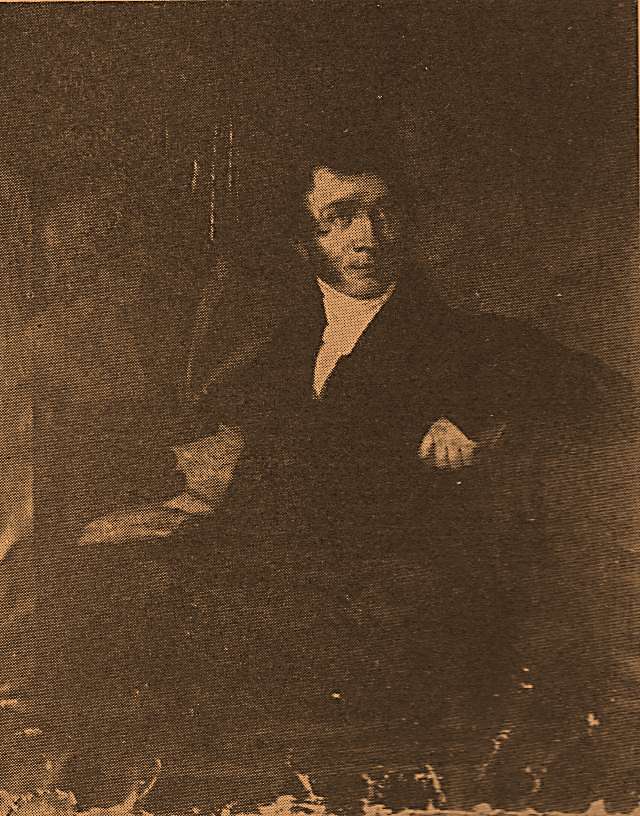 Portrait of Foscolo [oil painting] that survived before the earthquake in the Public Library of Zakynthos [from the periodical Eptanisiaka Fylla IX,1, 1976]
Thus was carried out in part the view expressed forty years earlier, in 1893, by Prefect Matarangas concerning the merger of the libraries. A Foscolian section in the Foscolo House, however, was not maintained. All the books in general were transferred and remained there until 1953, when they were destroyed by the earthquakes and the fire together with the books of the Public Library. In today's Public Library stamps of the Foscolian Library — in the centre Zakynthos with a lyre, around the rim MUNICIPAL FOSCOLIAN LIBRARY — on a few books that survived attest and preserve the memory of that library.
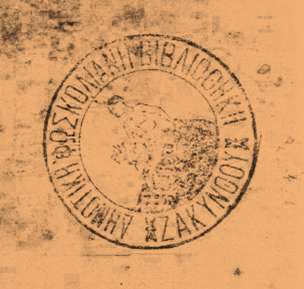 The type of stamp of the Municipal Foscolian Library. Zakynthos seated on a rock holds a lyre. The design is from an ancient Zakynthian coin. Around the rim the name of the Library
In 1940, on 6 November, three years after the transfer of the Foscolian Library's books, in the turmoil of war, Italian aircraft bombed the city of Zakynthos. A bomb that fell near the Foscolo House destroyed it, thus closing the first phase of the historical course of Foscolo's house.
The second period of its life began in 1941 with the Italian Occupation. The Italians' interest in Foscolo's house — whom they honoured as a son of Italy and whose remains had since 1871 lain in the Pantheon of great Italians at Santa Croce in Florence — was continuous. It had already been expressed in publications in 1882 and was stated again in 1885, with a proposal to purchase it by the Italian government through its consul in Zakynthos, Konstantinos Messalas.
The purchase of the house then by the Municipality and its use for purposes that honoured the poet averted that possibility.
When in May 1941 the Italians occupied Zakynthos they immediately took an interest in rebuilding the house of Foscolo destroyed by the bombing, with the ultimate aim of preserving the poet's house in his birthplace and of having it «become a centre of studies and a spiritual museum of Foscolian studies».
The Italians rebuilt the building with money that had been deposited in the Bank by Zakynthians of America for the needs of the families of Zakynthian soldiers of 1940. They rebuilt it on the site where it had stood before and to the same design it had had before, and within a few months, by December 1941, the building had been completed.
On its façade, by order of the Italian chargé d'affaires and at the expense of the Municipality of Zakynthos, in January 1942, Foscolo's phrase …. E a te il pensier was affixed in granite letters.
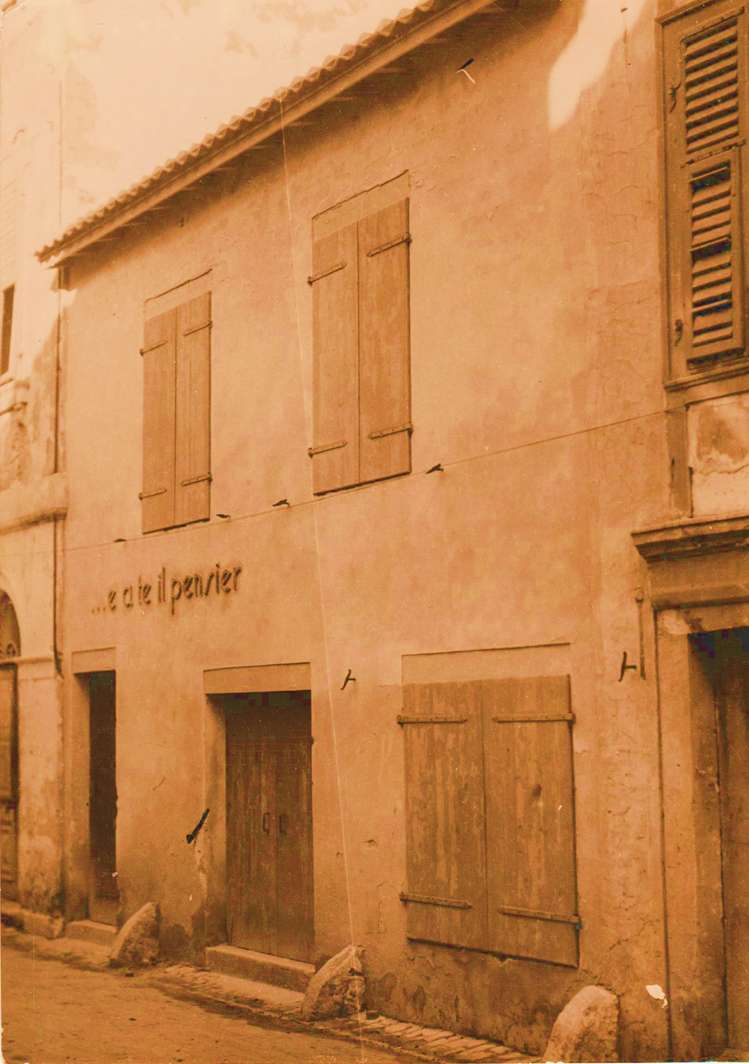 The Foscolo House in 1942. On the façade, by order of the Italians, the Municipality of Zakynthos placed in granite letters the phrase:….e a te il pensier
The design of the interior decoration and of the woodcarving work was drawn up by the Directorate of Fine Arts, a service the Italians had set up, on the basis of motifs, it is said, from the decoration of the Faneromeni, and the execution of the woodcarving was entrusted to the artist Nikolaos Andravidiotis.
For the fitting out and enrichment with furniture, heirlooms and books, in November 1941 the Italians formed a committee placed under the supervision of the school inspector Guido Fabris.
The Committee was named «For the House of Foscolo», Comitato pro Casa del Foscolo, and consisted of Loukas G. Karrer, Antonios Komoutos, Pan. Konidis, Dim. Koriatopoulos, Erm. Lountzis, Dion. Martinengos, Anast. Merkatis, Nik. Mouzakis, Dion. Romas, Sp. Giannopoulos.
To achieve its aims the committee addressed a personal letter to those it judged able to offer «generously to the “House of Foscolo” whatever they possess that may contribute to its better and more dignified appearance — namely, furniture of the late 1700s and early 1800s (desk-shaped chests, bookcases “BURO”, tables, wall plaques, chairs, etc.»), views and landscapes of Zakynthos of the Foscolian period, pictures, portraits, books, documents, tableware, etc., and noted that «The name of the generous donors shall remain in public esteem and honourable mention of it shall be made in the “House of Foscolo”».
In essence the committee then acted to reconstitute the Foscolian Library, in the same spirit and by the same means as when it was first created in 1888 — that is, through donations of every kind of book.
A chance event a few months later, on the night of 23–24 March 1942, also contributed to citizens' participation through collection contributions. The contributions were prompted as a mark of disapproval of the soiling by unknown persons with filth — because it offended national feeling — of the inscription «Zante d' Italia al Ugo Foscolo.1 Maggio 1941» (Zante of Italy to Ugo Foscolo, 1 May 1941), which the Italians had placed on the column of Foscolo's bust.
The committee in an announcement invited «[…] all fellow citizens as a mark of protest to compete for the swift and definitive arrangement of Foscolo's house. Monetary contributions, furniture, utensils, paintings, books etc. are accepted at the School Inspectorate of Zakynthos against receipt, per la sistemazione della Casa del Foscolo for the arrangement of Foscolo's house», while a special book with the names of all who would contribute to this — that is, to the arrangement of the house — would be kept and displayed in the poet's house.
The response was massive. Respect for the poet on the one hand and the evident Italian pressure on the other had their effect. Freelancers, merchants, civil servants, teachers and professors in the majority (Fabris after all was their superior), many of whose names have been preserved, offered money in the hard hours of the Occupation for the arrangement of the Foscolo House. As «the zeal of the locals in the collection that was conducted was exemplary» [by 10 May 254,750 Ionian drachmas had been collected], the embellishment works continued and they hoped that «very soon this new ornament of our place will be placed at the disposal of the public». The head of Civil Affairs, Parini, visited the house in June 1942 and «[…] admired the woodcarving of the ceiling, expressing himself enthusiastically about its executant, the artist Andravidiotis. […] he recommended to the School Inspector and the Directorate of Fine Arts the swiftest completion of the work, placing at the same time at their disposal whatever financial credit might be necessary for this purpose».
Upon completion of the works and of the interior decoration of the Foscolo House, in February 1943 Professor Dionysios Martinengos, one of the committee members, who had served as unpaid curator of the Foscolian Library from 1932 to 1934, was appointed curator of the Foscolo House to see «to the enrichment and preservation of the poet's house so that it may soon be delivered to the public».
Despite the references we have to the artistic interior decoration — Konomos too mentions it as an important work of Andravidiotis, noting that the Foscolo House was then used as a Museum — we do not know whether descriptions or photographs of this work, executed by a Zakynthian craftsman and essentially with the money and offerings of the Zakynthians, exist. We do know, however, the furniture of the Foscolo House at that time, which also came from Zakynthian offerings.
In September 1943, after Italy's capitulation and the departure of the Italians, the house passed to the management of its owner, the Municipality of Zakynthos. On 30 December 1943 it was received from the curator Dion. Martinengos by a committee appointed by the Prefect, consisting of the then General Secretary of the Municipality Nikolaos Chasalevris and the head of the Archive Dim. Koriatopoulos. According to the handover protocol the furniture of the little house was all walnut, of eighteenth-century craftsmanship. There were one settee, four armchairs, ten chairs, one bureau, one bookcase with 26 books and two tables. There was also an oil painting of Foscolo, a bust of him on a wooden pedestal [most probably the donation of Zoe Valaoritis], a walnut case containing two ribbons from the laying of a wreath on Foscolo's bust, and a bronze wreath dedicated to Ugo Foscolo [it was the wreath Italian officials laid in 1928].
A few days later, in the Allied bombing of 11 January 1944, the Foscolo House suffered serious damage from the explosion and the projectiles that were flung about. The outer doors and windows were broken, the roof suffered serious damage, the outer wall had damage and the inner walls had cracks, one of them being on the point of collapse.
Then the furniture and objects together with whatever else had been saved [inner shutters, doors] were transferred and safeguarded in the Town Hall building; all the outer frames were closed for reasons of security and protection of the interior, and the House of Foscolo remained thus until 1949 after it had been secured, in September 1945 under Mayor Dimitrios Koumanis, also by the demolition of the overhanging walls of the destroyed neighbouring buildings.
Thereafter the Foscolo House had various uses aligned with the postwar needs of the place.
In September 1949, under Mayor Matthaios Michalitse, repairs began so that a Vocational Craft School for Destitute Girls might be housed there temporarily, which the National Foundation then established in Zakynthos through the efforts of Prefect Dim. Sabatakakis. By June 1950 six looms intended for the School's operation had already been moved there.
The School operated on the ground floor of the house for a time and according to information had many pupils. In November 1951 the house as a whole, or at least the upper floor, appears to have been empty, since the Municipality then rejected as unprofitable a private individual's application to rent it. It is certain, however, that the School was not housed there in July 1952, since the Municipality was then paying a contribution toward the rent of a house in which the Vocational School was housed.
In March 1952, as the founding of a branch of the School of Fine Arts in Zakynthos by the National Foundation was under discussion, the Municipality was willing to grant «to the School of Fine Arts that is to be founded here the use o n l y of the Foscolo House for the lodging of artists arriving from time to time and for a period of four (4) years from the commencement of its operation», on condition that all repairs or alterations deemed necessary would be borne by the school and would remain to the benefit of the Municipality without compensation after the expiry of the grant.
Neither a branch nor a grant appears to have come about. In August 1952 the statue of the gladiator, a work by Tenerani, pupil of Canova, a donation of Maria Kaisara Romas to the Municipality from 1905, which until then had stood in a municipal garden and whose arms had been severed by the bombings, was transferred to the Foscolo House for safekeeping.
According to information, during this period the upper floor was used for lectures.
A year later, in August 1953, earthquakes and fire destroyed the Foscolo House and closed the cycle of this period of the house, which was bounded by two total destructions: the bombing of 1940 and the earthquake and fire of 1953.
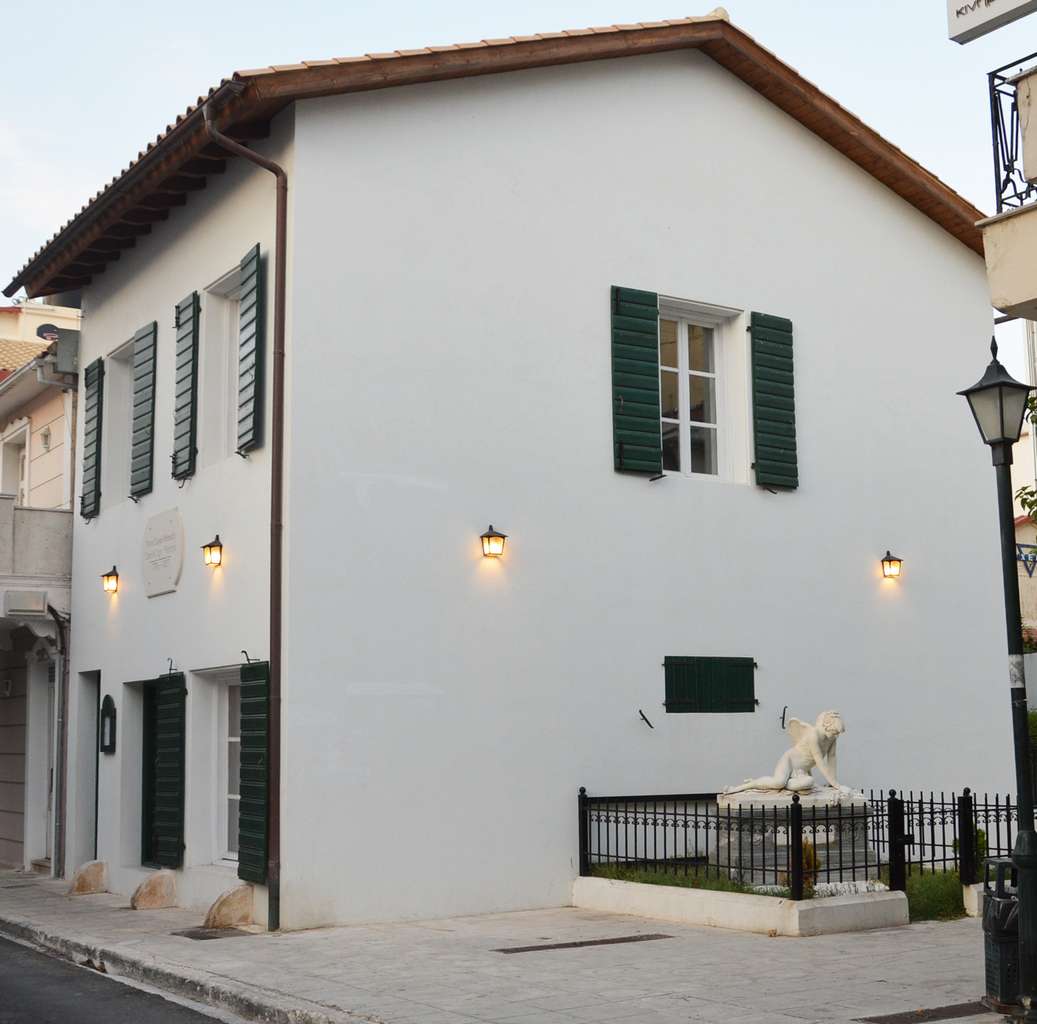
In the new town the site of the house remained empty until 1969. Then, through the efforts of Prefect Andreas Ioannou, the «spirit of sorrow», the mourning angel — a statue that had adorned the tomb of the twenty-year-old Eleni Stoupathi in the southern cemetery of Zakynthos, a work of the sculptor Io. Vitsaris — was purchased from the Stoupathis family and placed on the plot of the house, and a cenotaph was established in memory and honour of the poet of the Tombs. An inscription with his verses «o materna mia terra» remained to recall the poet and his Zakynthian origin.
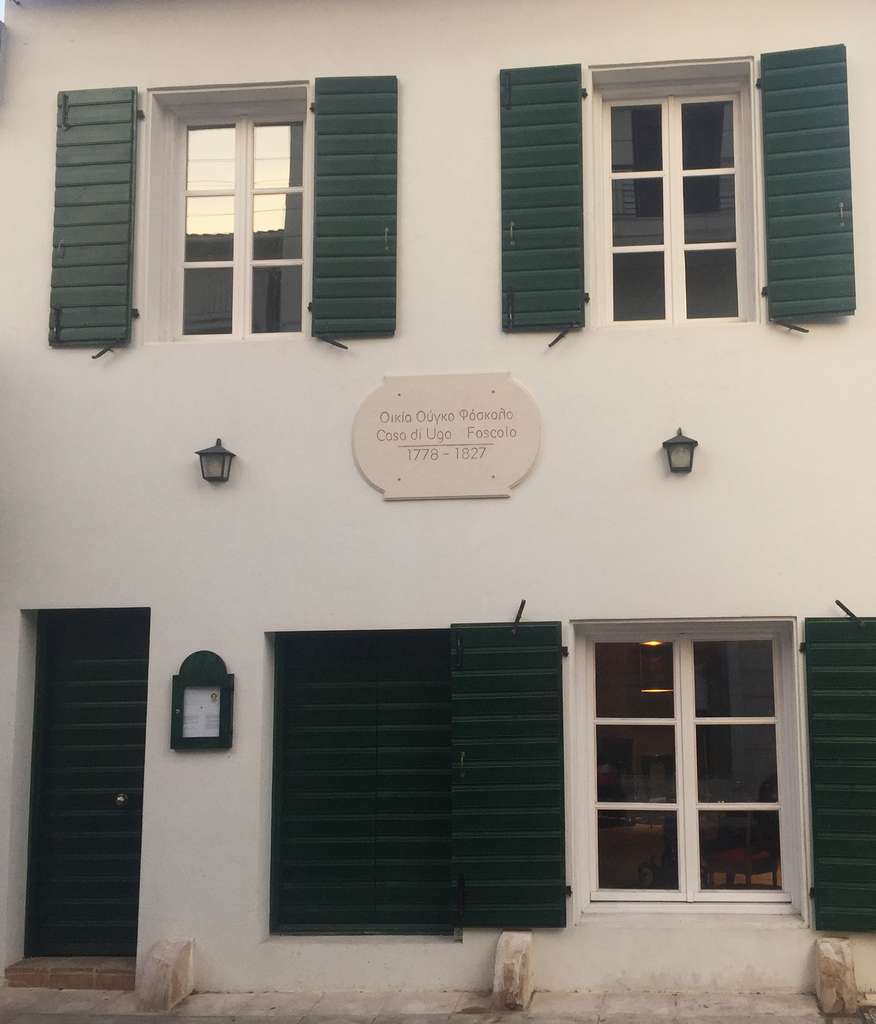
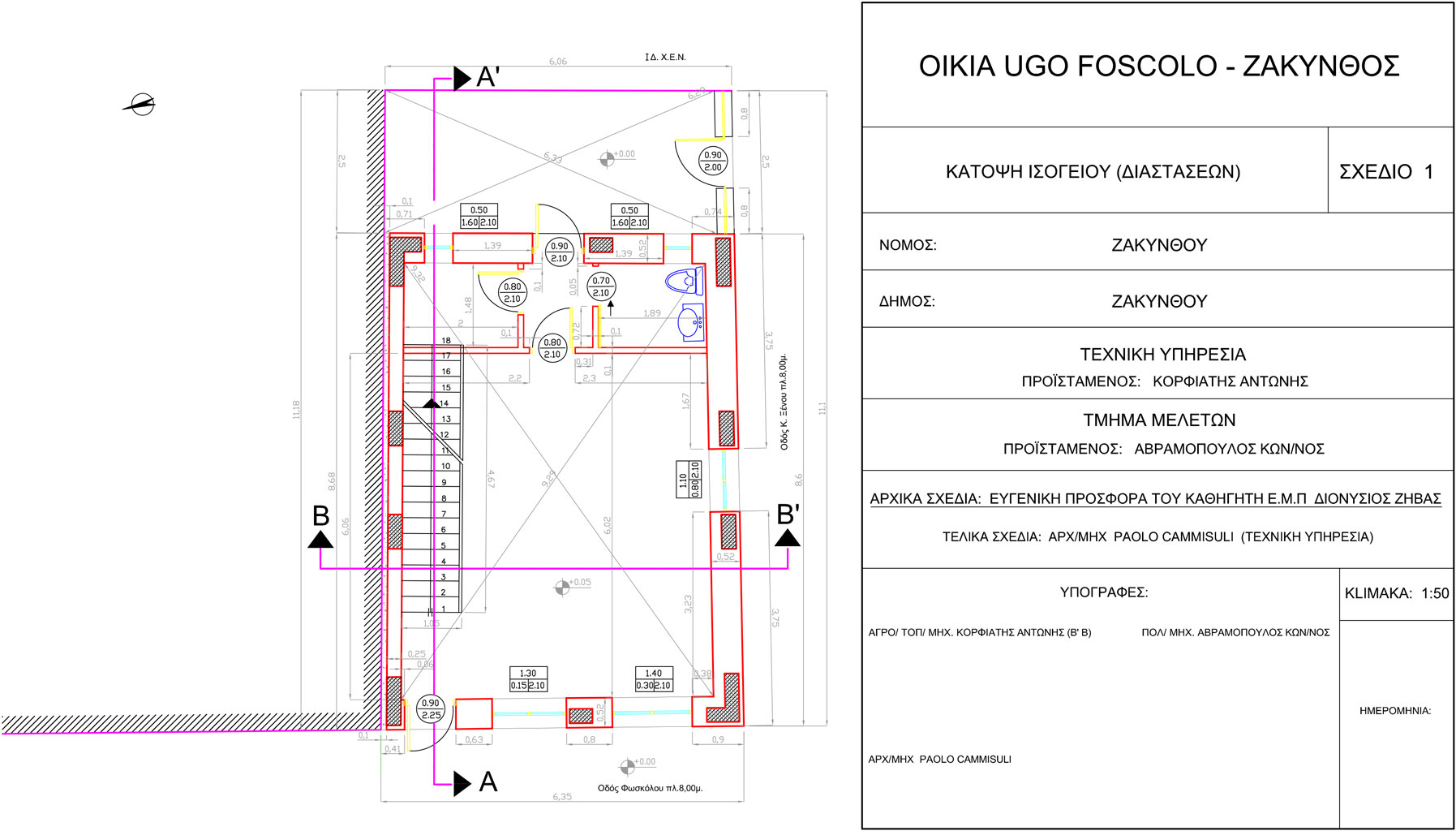
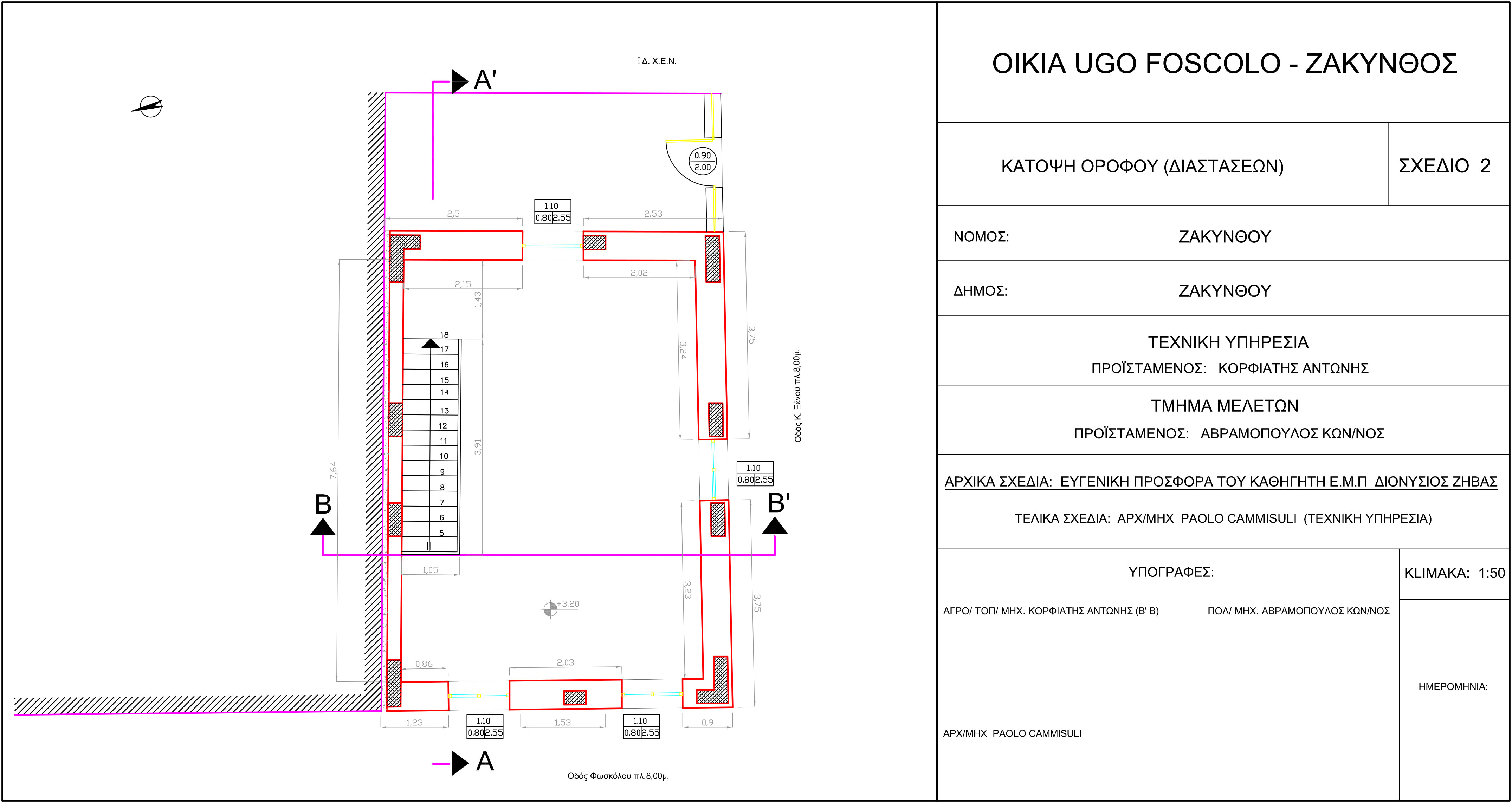
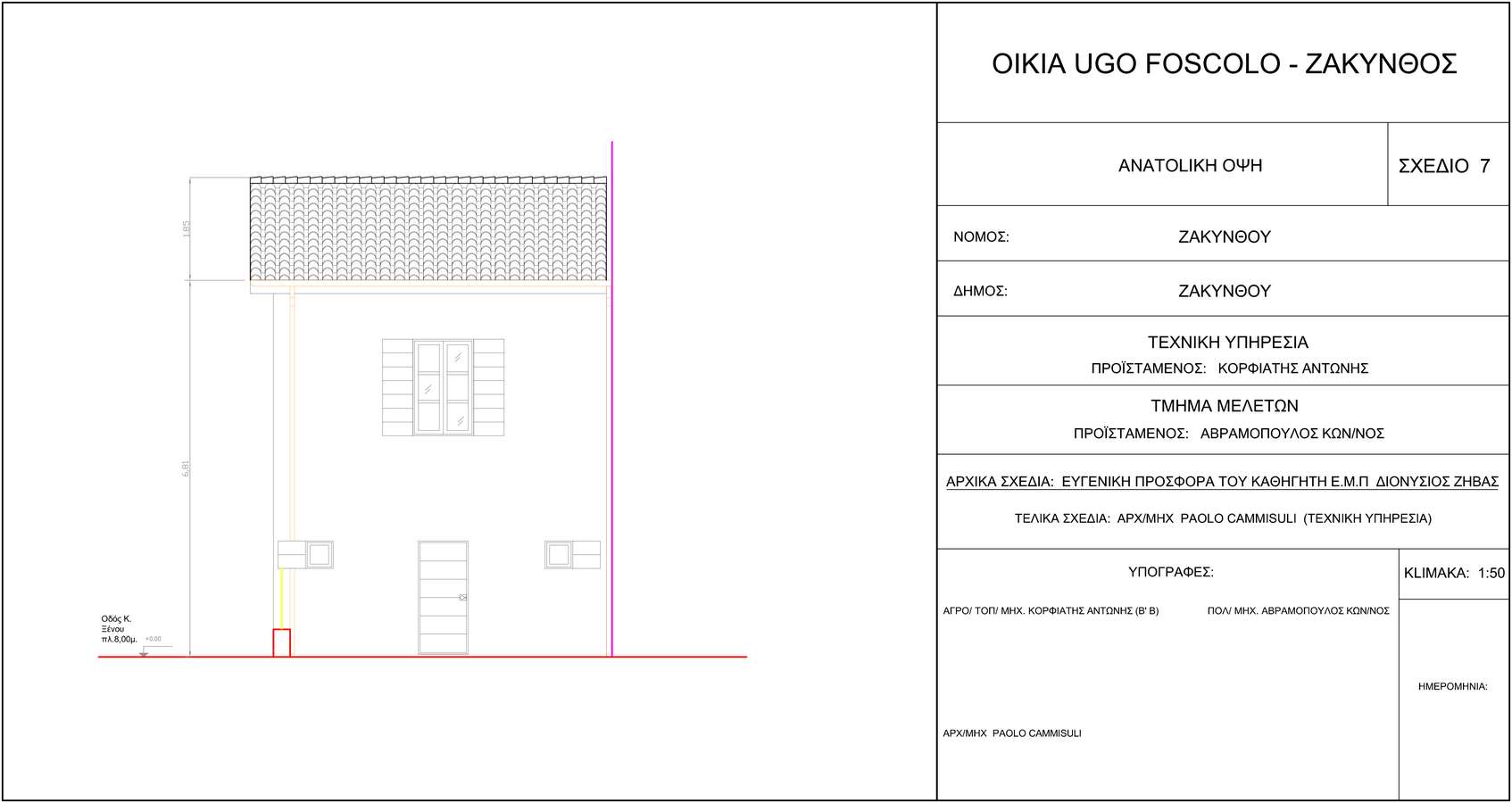
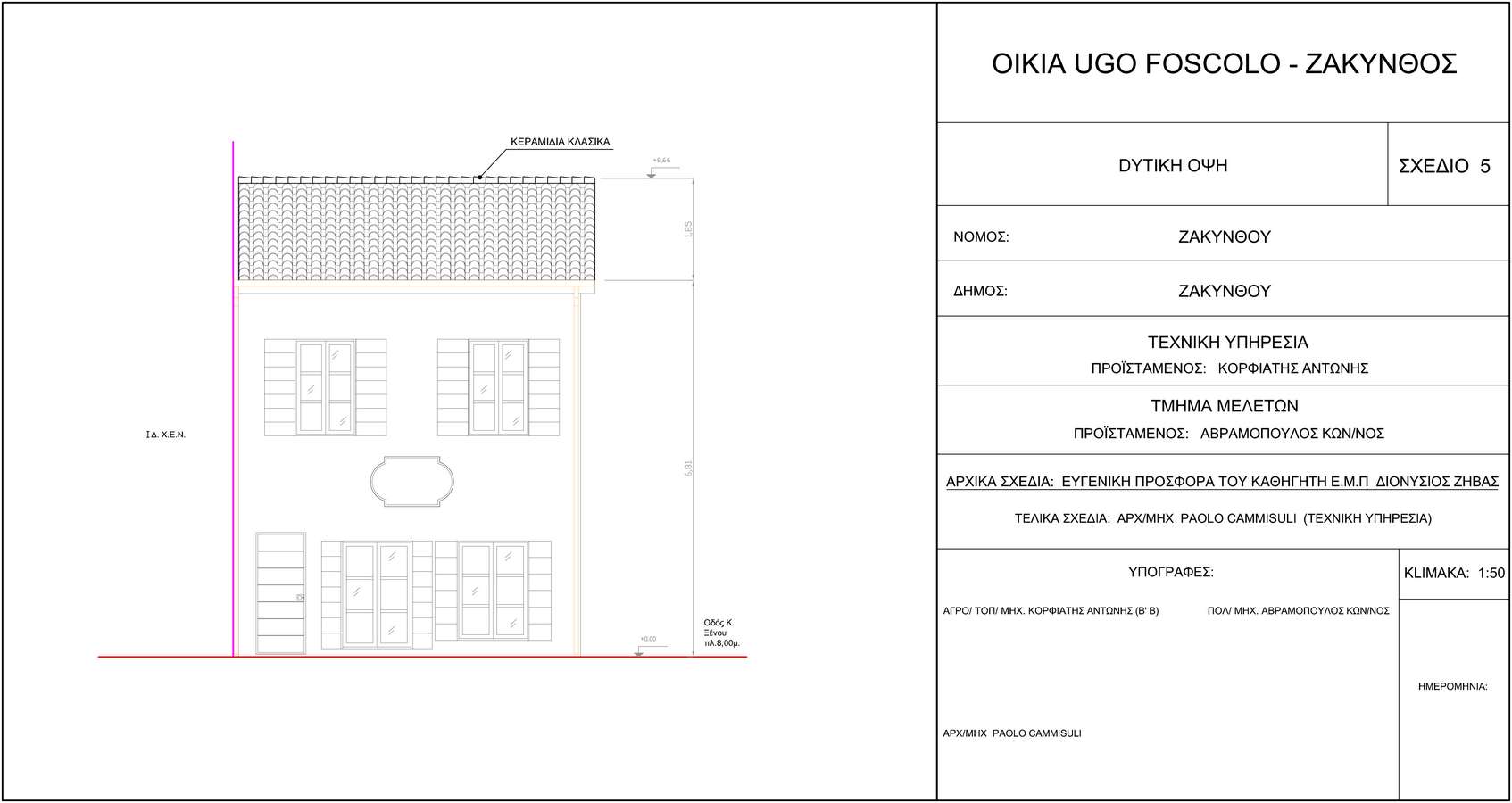
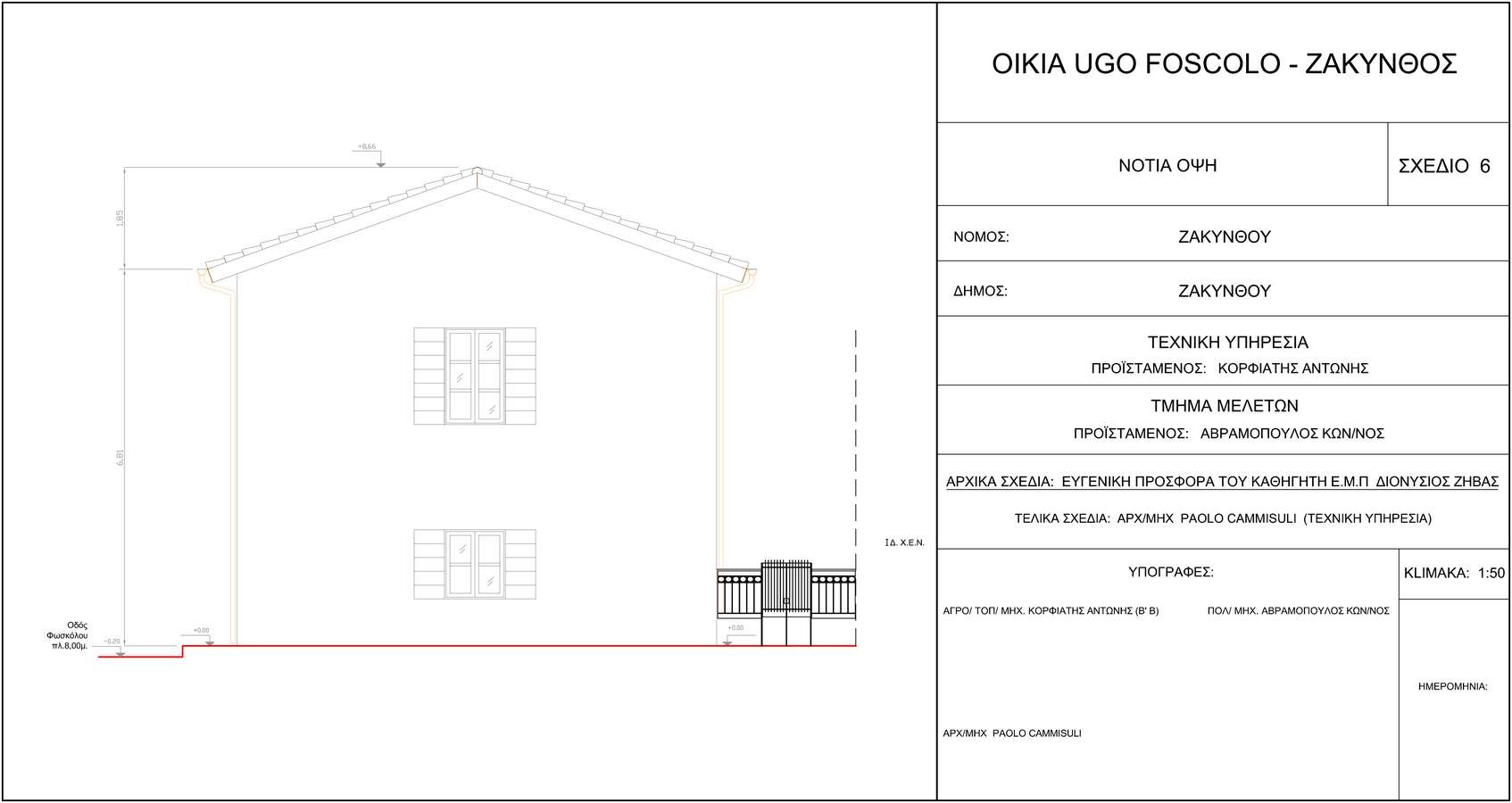
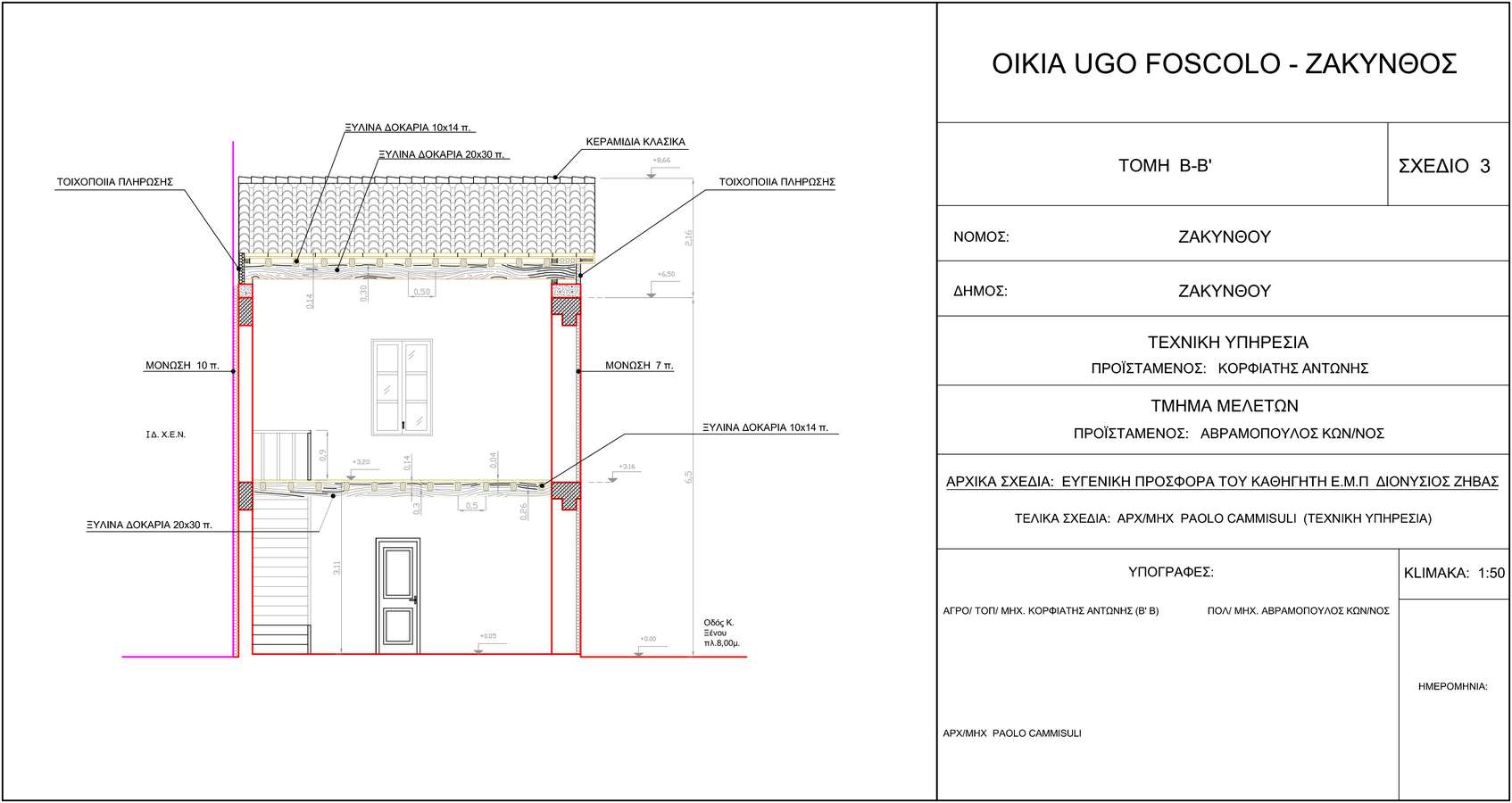
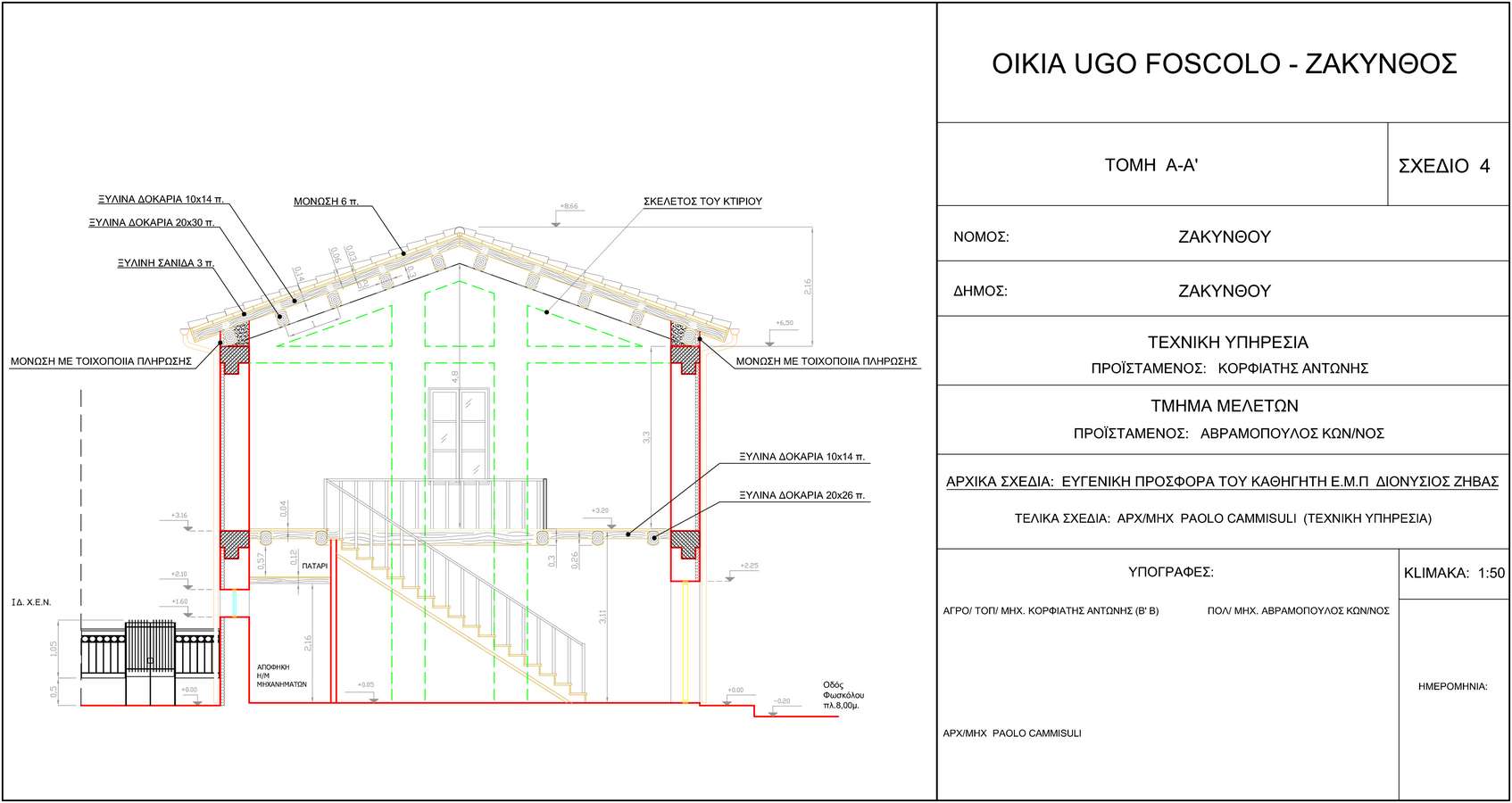
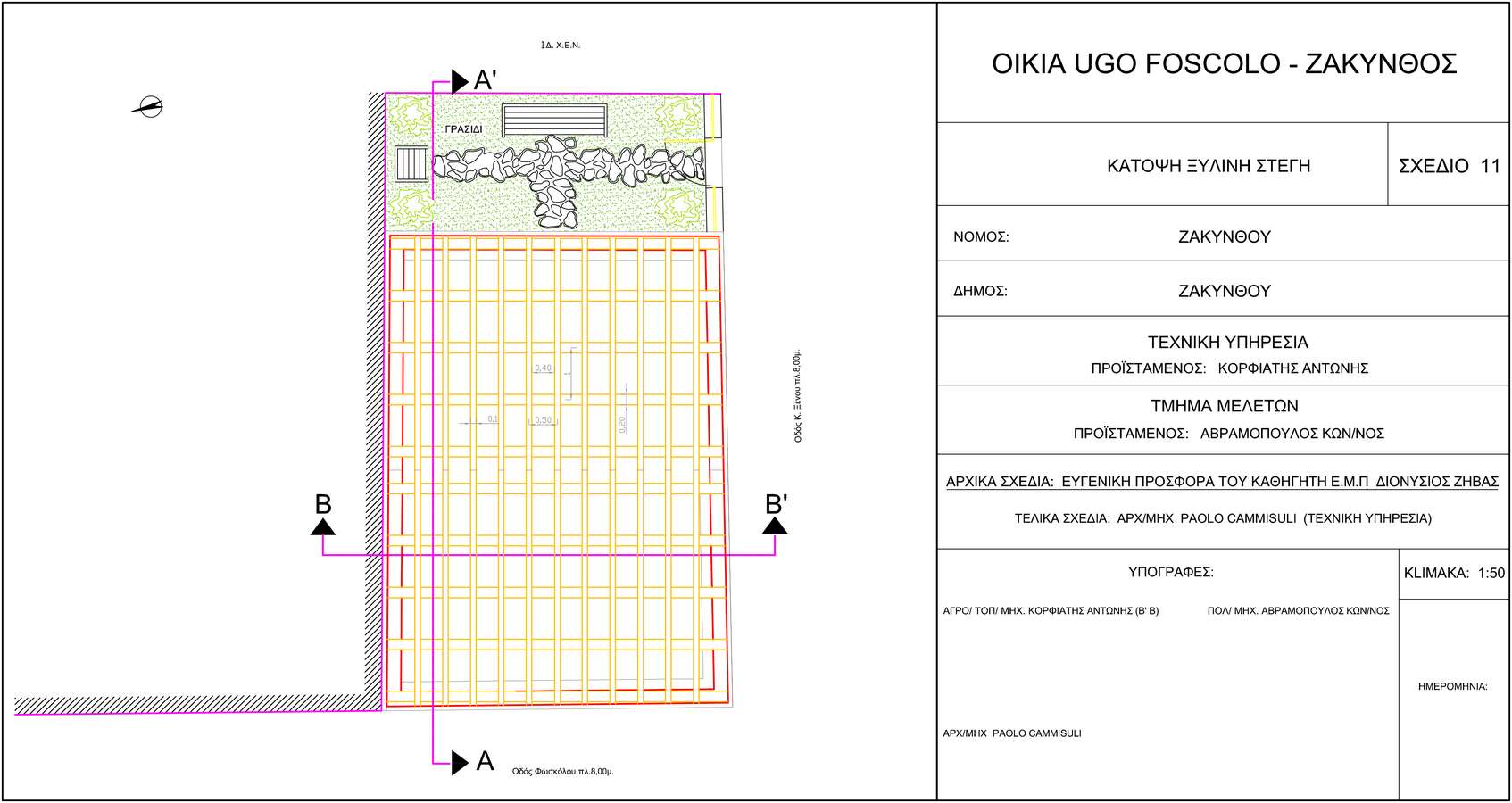
Sixty years had to pass from 1953 before Foscolo's house was erected again on the same site and once more to the same design, without one of its two neighbours — the land redistribution made it a corner house — through the efforts and persistence of a man gifted with sensitivity and knowledge, the late Nikolaos Lalotis, president of the Cultural Association of Zakynthos UGO FOSCOLO, founded for this purpose, and with the support of the owner, the Municipality of Zakynthos, and of the funder, the Regional Unit of Zakynthos. Fate brought it about that the man who took an interest in this and achieved it was one who in his youth knew well Foscolo's house in its first form, since in the early decades of the twentieth century the neighbouring house to the south belonged to his father, the notary Georgios Zivas-Lalotis.
Today, with its new legal form and under the management of the Cultural Association UGO FOSCOLO, the House of Foscolo inaugurates a new era, continuing to serve the purposes for which it was originally founded. Permanent or temporary exhibitions relating to the poet, loans of various materials, reproduction of the poet's works, publications, collaborations with local or other bodies in Greece and abroad that honour the poet, especially in Italy, conferences, and the operation of a digital library can make the Foscolo House, Museum-Library, an important centre for the study of Foscolo's work, just as previous generations from the beginning of its creation envisioned, believed and wished:
A holy shrine for every new creation, which will be lost only when the earth itself perishes.
Georgia Kokla-Papadatou